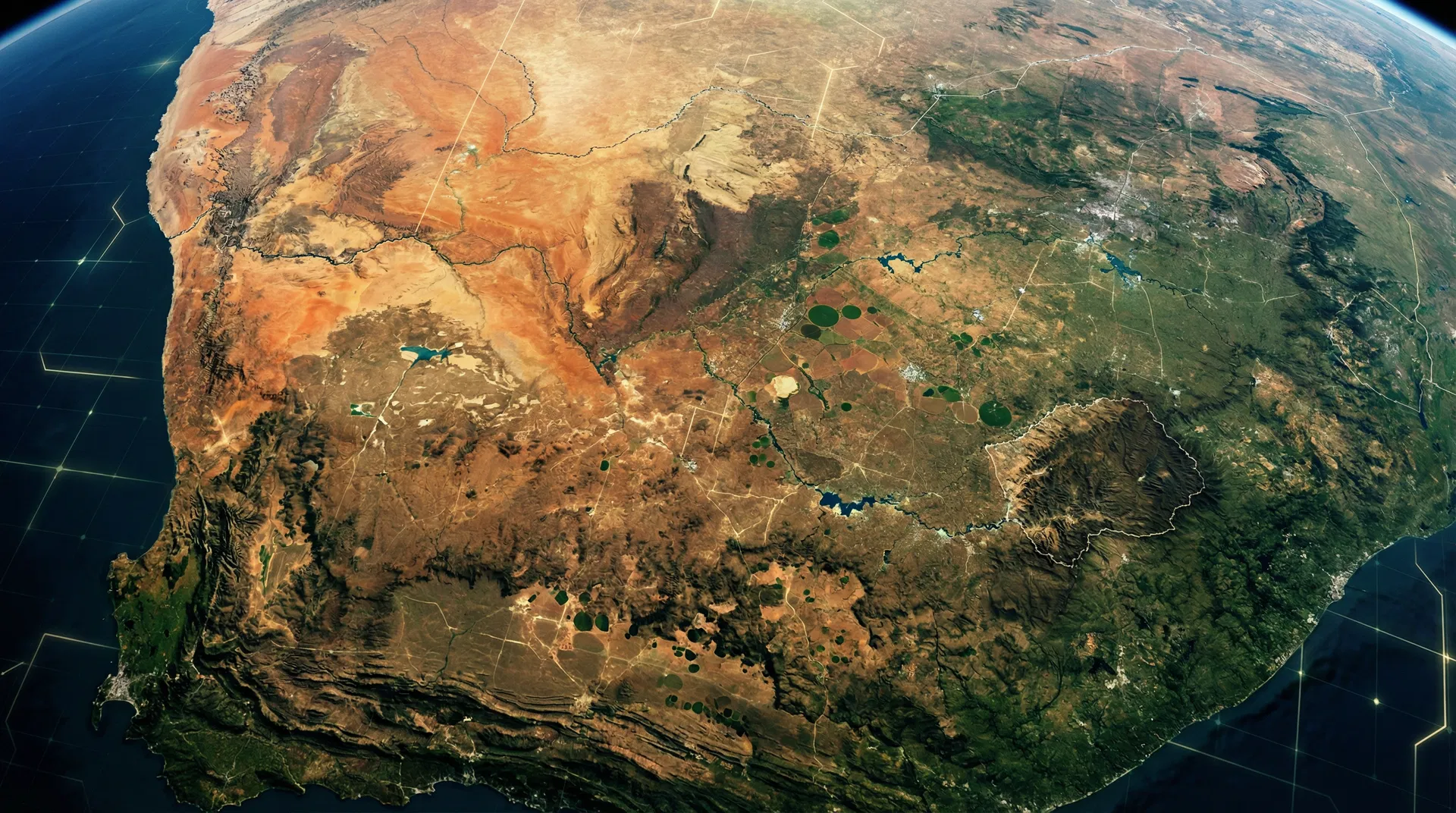
Satellite view of South Africa

GIS & Satellite Intelligence for South Africa's Digital Infrastructure

A unified geospatial platform integrating satellite imagery, IoT telemetry, and AI analytics across water, governance, assets, and energy β€” purpose-built for South African municipalities, Water Boards, and Eskom.

4
Integrated Solutions
3
Implementation Phases
5
Stakeholder Tiers
12mo
Full Deployment
SCROLL

One Platform. Four Solutions. Unified Intelligence.

Prepared for South African municipalities, Water Boards, and energy stakeholders seeking a credible, integrated digital transformation path.

A single GIS-centric platform can credibly support all four requirements by turning location data into an operational system of record. For water, the platform combines telemetry, smart metering, satellite indicators, and field workflows to detect losses, improve response times, and strengthen asset planning.

For government service delivery, it adds geotagged forms, AI-assisted routing, and citizen engagement workflows. For energy, it provides the spatial registry, portfolio visibility, and settlement-support data model needed for virtual wheeling across Eskom- and municipal-connected sites.

πŸ’§
Water Intelligence
Real-time NRW detection, reservoir monitoring, and leak localisation
πŸ›οΈ
Governance
AI-powered citizen workflows with location-aware routing
⚑
Energy Trading
Spatial registry for virtual wheeling across Eskom and municipal grids

Hub-and-Spoke Geospatial Platform

A shared geospatial data platform becomes the backbone. Domain applications consume trusted data and publish decisions, alerts, and transactions back into that backbone.

STAKEHOLDERS & DATA SOURCES
πŸ›οΈMunicipality / WSA
πŸ’§Water Board
⚑Eskom / Utility
β˜€οΈPrivate Generators
πŸ‘₯Citizens / Field Teams
DATA FLOWS BIDIRECTIONALLY
☁️
Application Layer
GovSuite Β· Digital Water Tower Β· Digital Asset Management Β· Virtual Wheeling Portal
πŸ€–
Intelligence Layer
AI/ML Analytics Β· Anomaly Detection Β· NRW Forecasting Β· Rule Engines Β· Workflow Automation
🌍
Geospatial Master Data
Asset Registry Β· Network Topology Β· Service Zones Β· Customer IDs Β· WSA/WSP Boundaries Β· PODs
πŸ›°οΈ
Observation & Ingest
Satellites Β· Drones Β· SCADA Β· AMI Smart Meters Β· CRM Β· Eskom Wheeling Data Β· Weather
πŸ”
Governance & Security
POPIA Compliance Β· Identity & Access Β· Audit Trails Β· Data Quality Β· API Controls Β· Evidence Retention
KEY TECHNOLOGIES
ArcGIS / QGISPlanet LabsESA SentinelMicrosoft AzureGoogle Earth EngineSCADA / IoTAI/ML AnalyticsPOPIA-compliant
πŸ‡ΏπŸ‡¦ SA-SPECIFIC CONTEXT
Water Boards
Established under the Water Services Act to assist municipalities with bulk potable water
Eskom Wheeling
Virtual wheeling pilot launching mid-2026; third-party wheeling policy active since 2025
WSA/WSP Model
Municipalities may delegate operations to WSPs while retaining WSA authority
POPIA
All data processing must comply with the Protection of Personal Information Act
CLICK LAYERS TO EXPLORE

Each architecture layer is interactive. Click any layer to see a detailed description of what it contains and how it contributes to the platform.

Four Requirements. One Integrated Platform.

GIS and satellite imagery act as a shared digital layer across all four solutions, providing real-time visibility, predictive intelligence, and spatial decision-making.
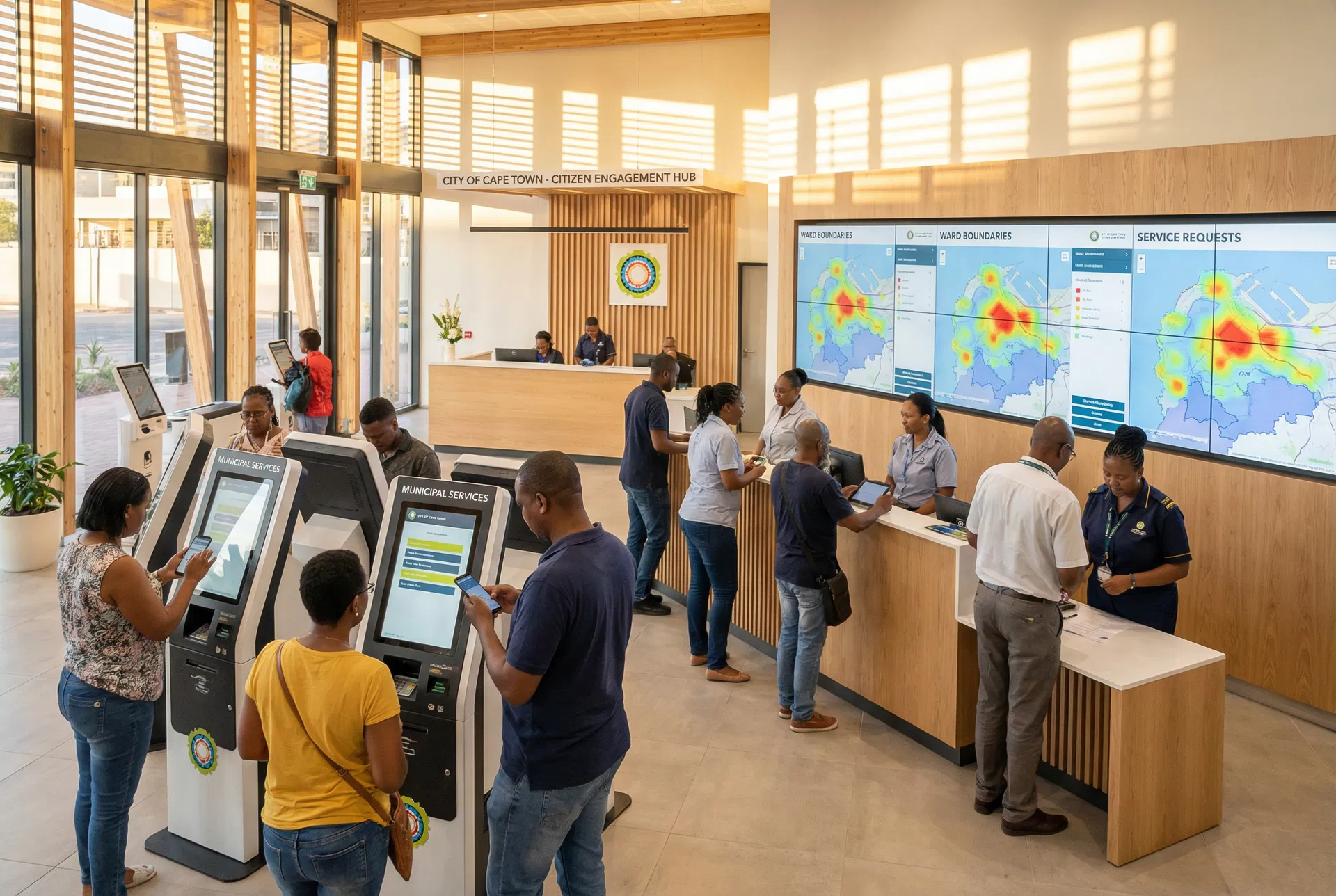
GovSuite
01

GovSuite

AI Workflows & Citizen Engagement

Geotagged Reporting: Citizens report water leaks, outages, and illegal connections with GPS-tagged inputs via web or mobile
AI Classification: AI classifies requests, checks duplicates, proposes priority, and routes cases to the correct municipal queue
Satellite Validation: Imagery validates reports β€” detecting flooding, land use changes, and contextual overlays like zoning
Smart Routing: GIS enables automated workflows based on location, severity, and service area boundaries
OUTCOME
Faster service delivery, better transparency, data-driven governance
πŸ‡ΏπŸ‡¦ Aligned with SALGA service delivery frameworks and municipal WSA/WSP delegations
Digital Water Tower
02

Digital Water Tower

Smart Water Command Centre
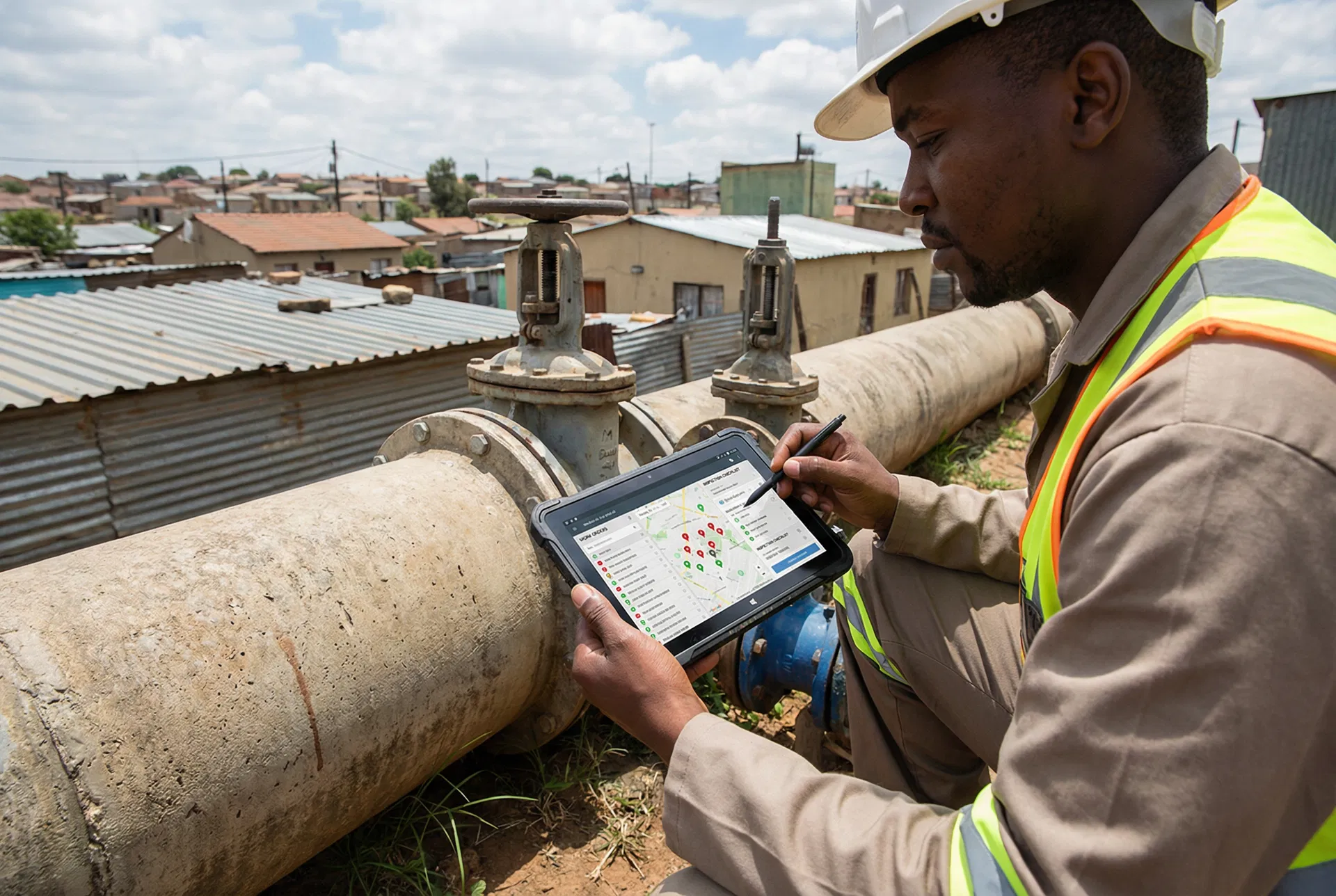
Real-Time Dashboards: Map-based views combining bulk supply, treatment, reservoir levels, pressure zones, and DMAs
Satellite Detection: Surface moisture, land subsidence, catchment monitoring, and reservoir trend analysis from orbit
NRW Analytics: Highlight non-revenue water hotspots, abnormal night flow, pressure anomalies, and excessive consumption
Predictive Alerts: Operations teams receive visual alerts and AI-recommended actions to reduce time-to-detect
OUTCOME
Early leak detection, reduced water loss, proactive maintenance
πŸ‡ΏπŸ‡¦ Supports Water Board bulk supply monitoring and DWS Infrastructure Asset Management Strategy
Digital Asset Management
03

Digital Asset Management

Water Infrastructure Intelligence

Spatial Asset Registry: Every pipe, valve, pump, reservoir, and meter receives a persistent geospatial ID with full lifecycle history
Mobile Field Operations: Field teams use mobile GIS for inspections, defect capture, work orders, and proof-of-work
Digital Twin: Complete digital twin of the water network enabling lifecycle tracking from installation to replacement
Capital Planning: Asset repository becomes the source for compliance, budgeting, renewals planning, and capital prioritisation
OUTCOME
Single source of truth, smarter planning, reduced downtime
πŸ‡ΏπŸ‡¦ Municipal and Water Board assets separated by owner/operator while viewed in one operational map
Virtual Wheeling
04

Virtual Wheeling

Energy Platform & Grid Intelligence

Spatial-Commercial Model: Platform stores generator, buyer, meter, POD, tariff, and network relationship data spatially
Portfolio Visibility: Supports multi-site corporate buyers across Eskom-connected and municipal-connected sites
Solar Irradiation Mapping: Satellite data maps solar resource potential and land suitability for renewable generation
Settlement Support: Business rules validate wheeling forecasts, delivery windows, and settlement-support calculations
OUTCOME
Efficient renewable energy trading, grid transparency
πŸ‡ΏπŸ‡¦ Aligned with Eskom virtual wheeling pilot (mid-2026) and third-party wheeling policy (2025)

Phased Delivery in 12 Months

A structured, risk-managed approach ensuring early value delivery while building toward full platform capability.

Phase 1Β·0 – 3 Months

Foundation

  • Stand up the GIS data model and integration layer
  • Load priority base data: assets, service areas, meters, treatment works, reservoirs, substations/PODs, and customer records
  • Launch priority dashboards and 2–3 high-volume citizen workflows
Phase 2Β·3 – 6 Months

Operations

  • Deploy Water Tower, mobile field operations, and automated work routing
  • Integrate telemetry, bulk supply data, and smart meter feeds where available
  • Begin AI-assisted anomaly detection and NRW hotspot scoring
Phase 3Β·6 – 12 Months

Optimisation

  • Add satellite/drone analytics, asset condition models, and portfolio forecasting
  • Expand Digital Asset Management and long-term capital planning
  • Introduce the virtual wheeling portal and settlement-support workflows once counterpart data is available

Recommended Stakeholder Operating Model

Ownership and operation are separated in the data model so municipal, Water Board, and Eskom-linked responsibilities remain clear and auditable.

πŸ›οΈ
Municipality / WSA
ROLE
Own citizen engagement, service delivery, local planning, local asset O&M, and customer-facing response
SYSTEM RESPONSIBILITIES
GovSuite workflows, local asset register, local dashboards, work orders, billing, and SLA reporting
πŸ”§
Municipal Utility / WSP
ROLE
Operate local distribution and treatment assets where delegated by the WSA
SYSTEM RESPONSIBILITIES
SCADA/telemetry ingestion, defect response, maintenance, and outage management
πŸ’§
Water Board
ROLE
Provide regional bulk supply, treatment, transfer schemes, and support to municipalities
SYSTEM RESPONSIBILITIES
Bulk telemetry, treatment works monitoring, scheme performance, bulk asset planning, and contract visibility
⚑
Eskom / Municipal Electricity Utility
ROLE
Network and market counterpart for wheeling-related data and settlement inputs
SYSTEM RESPONSIBILITIES
POD registration, tariffs, meter data, approvals, forecast, and settlement interfaces
β˜€οΈ
Private Generators / Traders / Corporates
ROLE
Participate in wheeling transactions and renewable energy procurement
SYSTEM RESPONSIBILITIES
Generation data, portfolio management, contract, forecast, and consumption reporting

What Determines Success

Five non-negotiable factors drawn from South African public-sector and commercial energy deployment experience.

01

Master Data Strategy

Establish a single asset and customer ID strategy early. Most downstream failures are master-data failures β€” a unified identifier scheme prevents duplication and data drift across systems.

02

Multi-Source Leak Detection

Do not treat satellite imagery as the only leak-detection mechanism. Combine it with telemetry, pressure, meter, and field evidence for reliable, actionable results.

03

Ownership vs. Operation Clarity

Separate ownership from operation in the data model so municipal, Water Board, and Eskom-linked responsibilities remain clear, auditable, and legally defensible.

04

API-First Integration

Use APIs and event-driven integration instead of manual spreadsheet exchanges wherever possible. This enables real-time data flows and reduces human error at system boundaries.

05

Governance from Day One

Build data quality, audit trails, access control, and evidence retention from the start. POPIA compliance, municipal delegations, and commercial energy processes all depend on it.

[1]
Eskom Distribution β€” Wheeling overview and virtual wheeling pages, including pilot phase launch information and policy references
[2]
Eskom third-party and net-billing wheeling policy (2025) β€” forecast and tolerance requirements
[3]
Department of Water and Sanitation β€” Water Boards established under the Water Services Act to assist municipalities with bulk potable water infrastructure
[4]
SALGA guidance and case studies β€” distinguishing Water Services Authority and Water Service Provider roles
[5]
DWS Water Services Infrastructure Asset Management Strategy β€” public-sector asset management context

Ready to Transform South Africa's Digital Infrastructure?

Let's discuss how this unified GIS and satellite intelligence platform can be tailored to your municipality, Water Board, or energy portfolio. Request a demonstration or detailed scoping session.

This proposal is confidential and prepared exclusively for the intended recipient. All architecture, pricing, and implementation details are subject to formal engagement and scoping.